






In this article
What makes the north different?
The north of Bonaire is hardly reminiscent of the south. Where the south is flat and barren, the north becomes hilly and greener, with winding roads and coastal viewpoints. You drive along cliffs, through valleys with cacti, and past the Gotomeer lake, and you pass through Rincon, the oldest village on the island.
This North Bonaire route will fill half to a full day, depending on how many stops you make and whether you also want to do Washington Slagbaai. The latter is a day in itself. The distances remain small: from Kralendijk to Rincon, you'll drive about 45 minutes. It feels longer than it is along the way because the landscape constantly changes.
What surprises many visitors is how green it can be here after rain. In the dry months, gray and brown dominate, but after a few showers, the entire area turns green within days.
| Time | Stop | Why |
|---|---|---|
| Early morning | Snorkel stops along the coastal road | The water is then at its clearest and calmest |
| 9:00 - 12:00 | Go-to-meet | View and chance of flamingos |
| Late morning | Corner | Coffee, the village, and the valley |
| 13:00 - 17:00 | Viewpoints along the north coast | Rugged coast and wide view |
| Afternoon | Back via the coastal road | Into the water again at Kralendijk |
Swipe the table sideways to see all columns.
the coastal road north
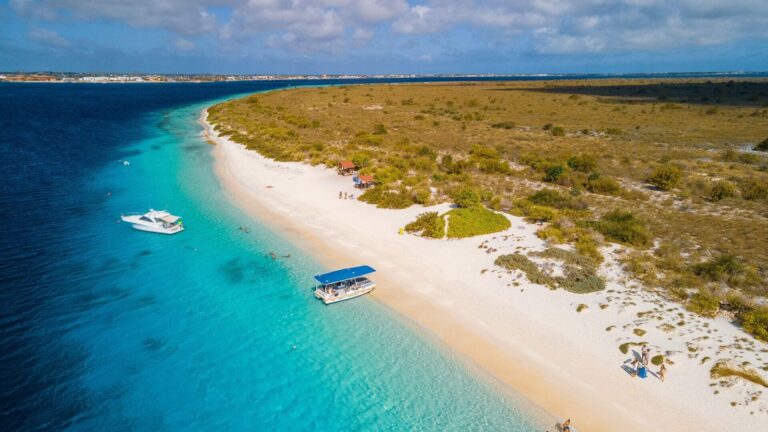
From Kralendijk, drive north along the coast. Almost immediately, you'll pass marked snorkeling spots with yellow stones, with the reef close to shore. Start with a short snorkeling stop while the water is still calm. Well-known spots on this stretch are manageable, although entry isn't equally easy everywhere.
More about that can be found in our guide to 1000 Steps on Bonaire in our guide about the best snorkeling spots on Bonaire. Divers often wait early at the yellow markers along this stretch. If a spot is crowded, drive on to the next one, as they are close together.
The Gotomeer
A little further inland lies Lake Gotomeer, a large, shallow saltwater lake where flamingos are found. From the higher ground, you can overlook the water and the hills behind it. You might have a chance to see the birds there, but it's never guaranteed. Stay by the road and use binoculars.
More about that can be found in our guide to Lake Goto on Bonaire. There are several spots along the road where you can look out. The highest spot offers the most beautiful overview, but the lower spots bring you closer to the water.
The lake is connected to the sea through the underground. Because of this, the water is salty and contains food that attracts birds, even though it is located a distance inland.
Rincon: The Oldest Village
Rincon lies in a valley between the hills. This location is no coincidence: the village was not visible from the sea, which offered protection from pirates. It is a quiet place with colorful houses, a church, and a few simple establishments where you can eat or drink something. The pace is noticeably slower than in Kralendijk.
For most visitors, it's a stop of half an hour to an hour, just enough to get out of the car for a bit. In the village, you'll also find a few small shops and sometimes local delicacies. Feel free to ask where to get something, as people here will easily show you the way.
The village is also the cultural heart of the island. Throughout the year, festivals and parades are held, of which the harvest festival is the most famous.
Lookouts and the rugged north coast
From Rincon, you drive towards the north side, where the road runs along cliffs and offers views of the sea. It is windy here, and the waves are much rougher than on the west coast. There are viewpoints along the way where you can stop to look. Stay away from the edge, as the rocks are sharp and slippery from the spray.
Swimming isn't a good idea on this side. For that, you'd go back to the sheltered west coast. The wind is almost always strong here. Open your car door carefully and watch out for loose items you take to the viewpoint.
In some places, you'll see natural bridges and coves carved out by the waves. Stay at a distance from these areas, as the edge is less stable than it appears.
See the North with a guide
If you'd like to hear the story behind the landscape, an island tour is a good alternative. You'll get explanations about Rincon, the Christoffelpark, and the nature along the way. Such a tour usually combines the north with the south, allowing you to see both sides in one day. More on this can be found in our guide about the best island tours on Bonaire.
A guide usually knows where the flamingos are that week and which side roads are currently easy to traverse. This saves you searching and taking wrong turns.


Washington Slagbaai: plan separately
Further north, Washington Slagbaai National Park begins. The park has its own opening hours, a last admission time, and its own conditions for vehicles. The route through it takes a large part of the day, so do not combine it with this round trip. Plan a separate day for it.
What to expect in the park is in our guide about Washington Slagbaai National Park. If you arrive at the park late, you will no longer be admitted. Estimate your travel time from Kralendijk generously, especially if you plan to stop along the way.
How long does the route take?
Driving directly, you'll be on the road for about two hours. With stops at the lake, in Rincon, and at the viewpoints, you can fill half to a full day with it. If you also want to go snorkeling, plan for a full day. Start early, as the water is calmest in the morning.
A detailed counterpart for the other side of the island is in our guide about the South Bonaire route. If you want to keep it compact, just visit Gotomeer and Rincon and ride back the same way. That can be done in a morning.
Don't plan a ride on your arrival day. After a long flight, a day with a lot of sun, wind, and winding roads is more strenuous than it seems.
Roads and car choice
The main roads in the north are paved and easy to navigate with a regular rental car. However, they are narrow, winding, and sometimes have loose animals on the road. Some of the side roads are unpaved. These are usually passable, but can become more difficult after rain. Don't go on them if you have any doubts.
There are separate vehicle requirements for Washington Slagbaai. Check these with the park itself beforehand. Drive slowly around the bends. Donkeys and goats walk along the road and are sometimes right in the middle of the asphalt just around a bend.
What to bring
Water is the most important, as there is almost nothing for sale along the way. Also bring sunscreen, a hat, sunglasses, and binoculars. Fill up your tank before you leave and take some cash for Rincon. Snorkel gear and water shoes are useful if you want to go into the water along the way.
A complete list is in our guide on what to pack for Bonaire. Wear a hat or cap that fits snugly. Anything loose will be blown away immediately at the viewpoints.
Bring an extra bottle of water. If you get stuck or the drive takes longer than planned, you'll want to have it with you.
When is the best time?
Go early. It's cooler then, the animals are more active, and you have the best chance of clear water when snorkeling along the way. After a rainy period, the north is noticeably greener. So, if you want to see the landscape at its most beautiful, it's better to plan the drive at the end of the wet season.
More about months and weather is in our guide about the best time to visit Bonaire. Do not drive back in the dark if it is not necessary. The roads are unlit and animals are difficult to see then.
Out and about with kids
For children, the ride itself is less interesting than the stops. So, alternate: look out at the lake for a bit, have a drink in Rincon, and then go into the water. Keep the day shorter than you would without children. A half-day in the north with a beach afternoon afterward works better than the entire loop with all the stops.
More tips can be found in our guide on Bonaire with children. Make it a scavenger hunt along the way: whoever spots a iguana, a donkey, or a flamingo first. That keeps the drive fun for longer than just the view.
Take a short break in a shady spot along the way. These are scarce, so if you come across one, that's the moment to stop.
Frequently Asked Questions about the North-Bonaire Route
How long does the North Bonaire route take?
Driving alone takes about two hours. With stops at Lake Goto, in Rincon, and at the viewpoints, you'll be on the road for half a day to a full day.
Can you drive north with a regular rental car?
The main roads do. Some of the side roads are unpaved, and Washington Slagbaai has separate requirements for vehicles. Check these with the park in advance.
Can the route be combined with Washington Slagbaai?
Better not. The park takes up a large part of the day and has its own opening hours. Plan a separate day for that.
Will you see flamingos on the way?
At Lake Goto, you might get lucky, especially early in the morning or late in the afternoon. They are wild animals, so nothing is guaranteed.
Can you swim along the way?
On the west side, yes, the snorkeling spots are along the coastal road. The north coast itself is rugged and not suitable for swimming.
Is food and drink available along the way?
In Rincon there are a few simple amenities. For the rest of the route, bring your own water and snacks.
Would you prefer to ride along and hear the story? Then check out which activities and excursions fit your trip.
 Things to do on Bonaire when it rains
 Bonaire in 10 days: complete travel planning
 Bonaire in 14 Days: Complete Travel Planning